
Man buys 17th-century painting online—realizes it might be hiding a secret
A man has found himself at the center of a cultural mystery as he tries to learn more about an old painting he bought, after realizing there is more to the art than meets the eye.
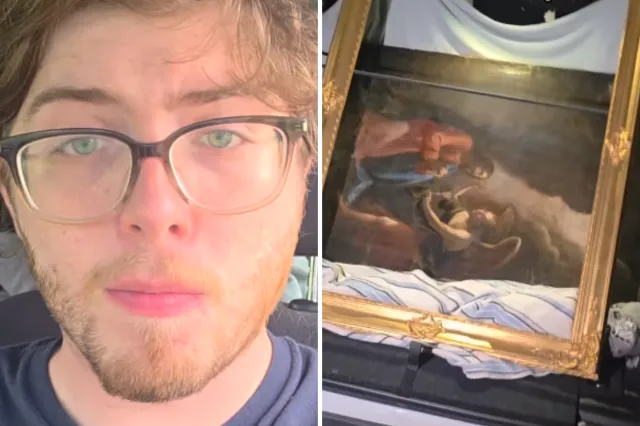
Mark Byram II, 24, believes he may have found a Renaissance-era painting while hunting for art on Facebook Marketplace.
Byram told Newsweek that he was "doomscrolling" on the online marketplace when he "came across a simple listing for a 17th-century painting."
Read More on Life
"It was about a three-hour drive, but I'm always down for some adventure," he added.
The woman he bought it from was "wonderful," Byram said, and told him that she was downsizing and wanted the painting to go to a "worthy home."
The canvas painting appears to depict a kneeling Jesus, his hands clasped and surrounded by clouds, speaking to a winged angel who is offering him a chalice. It may represent the Agony in the Garden, where Jesus prayed in anguish after the Last Supper, and ahead of what he knew would be his arrest and death.
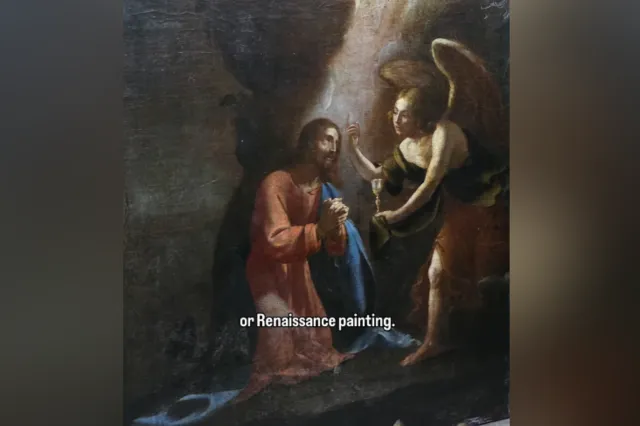
But Byram began to notice details about the painting that made it seem like there was more to it than meets the eye.
"The painting is a total anomaly," he said. "It contains a lot of interesting details that hint at a much richer past than just being an old, cool painting."
Byram said the painting appears to be cut and placed onto another canvas, and the handmade nails on the side appear to be from around the 18th century, which "seem to imply that there was an attempted restoration at some point."
Byram has received suggestions from some experts, and he said one former art appraiser suggested "it looks like both of the faces and a larger part of the right side of the canvas has been overpainted—in a much lower quality."
While Byram hasn't had an "official technical analysis or appraisal" on the artwork yet, he says "a few experts" have looked at the painting—and some believe it could have been created in a school or "workshop circle," sometime in the 17th century, somewhere in Italy.
"I've had a lot of different answers—Florence, North Italy, Spain—by a lot of different experts so far," Byram said. "I'd still like to do more analysis on the painting."
What he does with the artwork, he said, depends on what he learns about it—and he is welcoming anyone with this expertise who may be willing to help to contact him through his Instagram page, @markbyram2.
Newsweek spoke to appraiser Reyne Hirsch, owner of Dallas Auction Gallery, who called the social media mystery a "fun" one, and said that, in her opinion, it could be "more Spanish Baroque than Renaissance."
"The dramatic lighting and soft brushwork is the giveaway. Renaissance works tend to offer daylight type lighting and the figures are modeled with shadows not such dark contrast," Hirsch said.
"Spanish Baroque images are often met with a single light source, and the figures with more emotion—Renaissance figures emotions are more subdued."
Hirsch pointed out that this particular scene depicting Christ with the angel is "one of the most repeated compositions in Christian art," with famous artists from Raphael to El Greco creating their own takes on it.
Because the masters were so fond of this scene, Hirsch said, it "shows up often at flea markets, estate sales and even Facebook Marketplace."
"It is highly doubtful this is a long-lost master, but yet a work by a student or workshop of the period," she said.
But, she added, "it's still worth possibly a few hundred to perhaps low thousand dollars. A black light will quickly help determine some of the perceived restoration."
Byram told Newsweek that he is keeping his expectations to a minimum, as he put it: "I think everyone always thinks they found a lost da Vinci, and, while that intrigue narrative is a great, fun story, even the simpler historical mystery of provenance is one that I'd love to solve eventually.
"Even if it's a simple nobody apprentice, the educational potential is interesting and the work is fantastic and vivid. Even if the painter was lost to history, it's still a worthy heirloom for generations to come."
That said, Byram added: "If it's a priceless masterwork, I've always thought it would be fun to hit the museum circuit!"
Contact Newsweek editors on this story: Rebecca Flood and James Debens