
How Social Security benefit payments changed over the last year
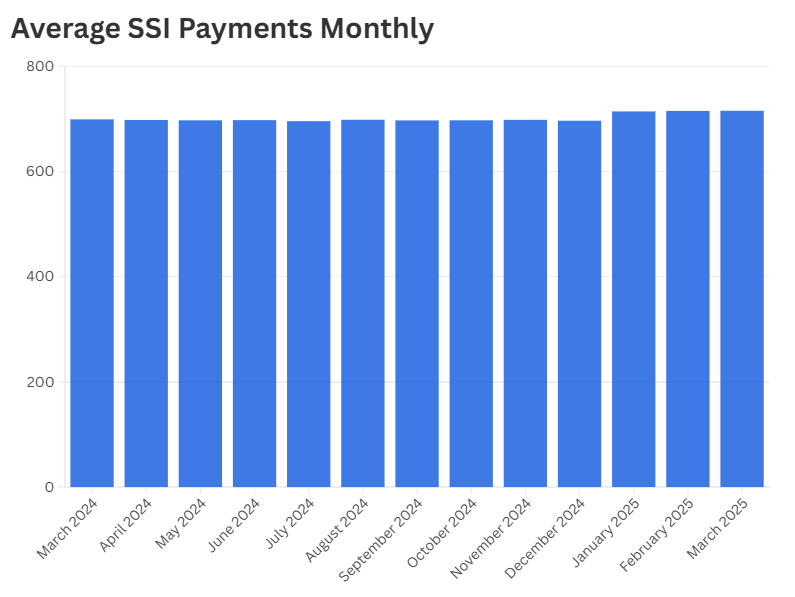
Americans relying on Supplemental Security Income (SSI) have seen a modest but steady increase in their monthly payments, over the past 12 months.
The change represents a 2.3 percent increase in monthly average payments over the year, closely mirroring the 2.5 percent Cost-of-Living Adjustment (COLA) announced by the Social Security Administration (SSA) for 2025.
Why It Matters
The changes in Social Security payments impact millions of Americans who depend on the benefits to meet their basic living expenses.
Even slight monthly increases can make a meaningful difference for those on fixed incomes, especially during periods of rising costs. The most recent COLA, announced by the SSA, aims to preserve the purchasing power of beneficiaries amid inflationary pressures.
For 2025, the COLA was set at 2.5 percent, affecting Social Security and SSI benefits. These annual adjustments are designed to ensure that benefits keep pace with inflation as measured by the Consumer Price Index for Urban Wage Earners and Clerical Workers (CPI-W).
What To Know
From March 2024 to March 2025, the average SSI payment has increased by $16.36 per month, translating to a modest year-over-year percentage gain. The average benefit amount rose from $699.22 in March 2024 to $715.58 in March 2025. The increase is in line with inflation and $699.22 in March 2024 has the same buying power as $715.94 in March 2025, according to the U.S. Bureau of Labor Statistics.
The increase was most notable in January 2025, when the average monthly payment jumped from $696.70 in December to $714.37. The surge aligns with the start of the new COLA adjustment cycle.
While average payments rose, the number of recipients saw only minor fluctuations. In March 2024, there were 7,403,919 recipients; by March 2025, that number had slightly increased to 7,414,184. This stability in recipient numbers suggests that while benefit levels are rising, there has not been a major shift in the demographic relying on the payments.
The SSA has also highlighted efforts to expedite retroactive payments and implement enhancements tied to broader legislative changes, such as the Social Security Fairness Act.
In a February 2025 update, the agency noted it was increasing monthly benefits and beginning backdated disbursements under the new law.
What People Are Saying
Alex Beene, a financial literacy instructor for the University of Tennessee at Martin, told Newsweek: "After the dramatic fluctuations in some benefits programs over the pandemic era, the SSI numbers over the last year demonstrate a stabilization both of recipients and the amount they're receiving. It can be viewed as a good sign, in some ways, because it equates to fewer inflationary pressures, even if pricing remains high for many everyday items."
Michael Ryan, a finance expert and the founder of MichaelRyanMoney.com, told Newsweek: "The average monthly change since March has been pretty stable after that initial January increase. What's interesting is that the COLA for 2025 is actually dropping to 2.5%, which tells us inflation is cooling down a bit."
Drew Powers, the founder of Illinois-based Powers Financial Group, told Newsweek: "In real terms, seniors are a little worse off in 2025 because their SSI payments are not keeping up with the inflation they experience. Over time, these small differences add up and compound into a serious shortfall for the elderly.
Kevin Thompson, the CEO of 9i Capital Group and the host of the 9innings podcast, told Newsweek: "If you look closely, you'll notice a steady rise in recipients after September 2024. That lines up with the policy change where food was no longer counted as in-kind support, which helped boost eligibility and benefit amounts."
What Happens Next
Recipients can expect continued COLA adjustments each year based on inflation metrics, with the next update to be announced later in 2025 for January 2026.
The SSA is expected to maintain close monitoring of economic conditions and update payment structures accordingly.
Meanwhile, legislative attention remains focused on the long-term solvency of the Social Security trust fund.
Without reform, current projections suggest that funding shortfalls could begin in the mid-2030s, potentially reducing benefits unless corrective action is taken by Congress.
Until then, beneficiaries can anticipate incremental changes tied to the cost of living, with annual COLAs serving as the primary mechanism for keeping payments aligned with economic realities.