
Greenland map shows "strategic resources" eyed by US, China
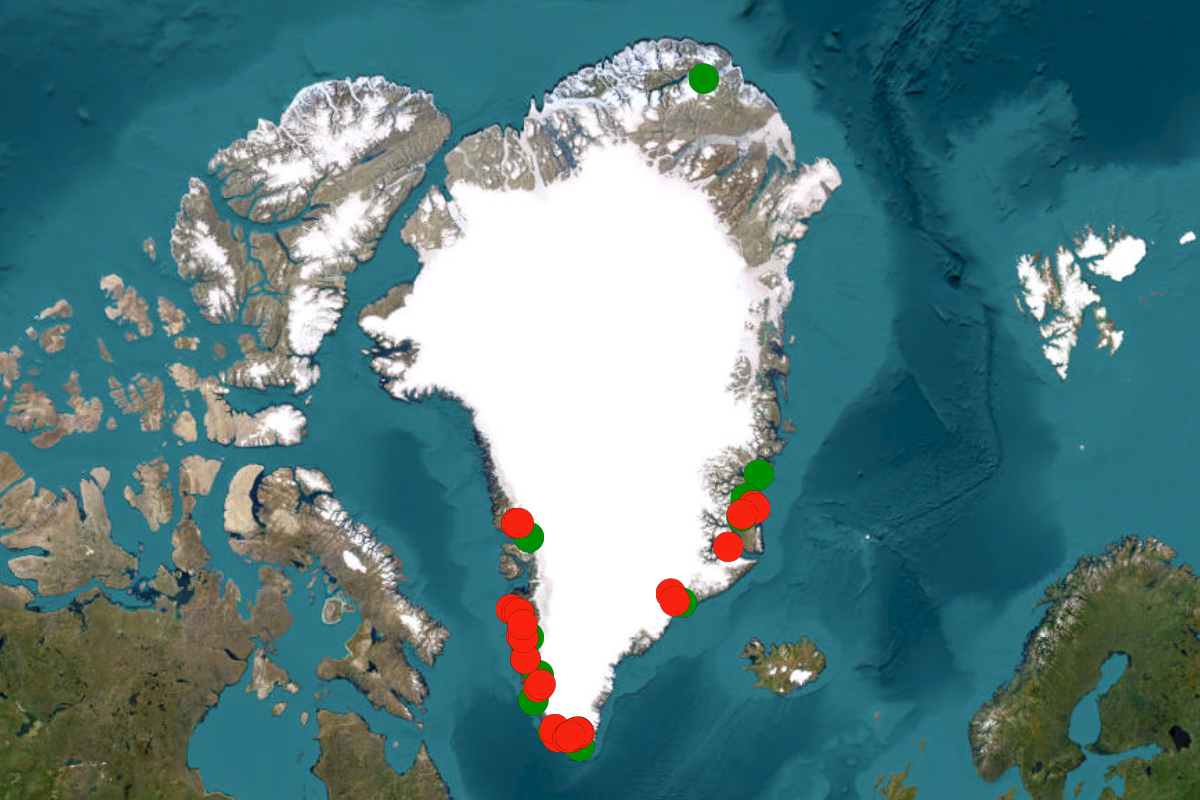
As President Donald Trump's administration pushes forward with its quest to obtain control over Greenland, Newsweek has mapped the minerals that, in addition to national security concerns, may be fueling this interest.
During his recent unsolicited visit to the autonomous territory, Vice President JD Vance reiterated the claim that American stewardship was the only thing that could protect Greenland from the threats posed by China and Russia. These countries, he said, are exhibiting an increased interest in Arctic naval routes, as well as the region's mineral endowment.
Why It Matters
Trump's desire to increase America's access to critical minerals has emerged as a cornerstone of his foreign policy agenda, with experts telling Newsweek that this lies behind his offer to purchase or acquire Greenland by other means, as well as the focus placed on minerals in Ukrainian peace negotiations.
Alongside hoping to expand access to critical minerals from abroad, and the 17 highly sought-after rare earth elements, the desire to reduce the U.S.' reliance on imports from China has recently prompted an executive order focused on boosting America's domestic production capabilities.
What To Know
The southern portion of Greenland is rich in a number of minerals, including widely used metals and several deposits of rare earths (in red on the above map).
According to a 2023 report, Greenland is in possession of 25 of the 34 minerals deemed "critical raw materials" by the European Commission, and those "strategically important for Europe's industry and the green transition."
Capitalizing on Greenland's mineral wealth has run into numerous obstacles, however, including a lack of necessary infrastructure and domestic opposition stemming from environmental concerns.
As a result, there is heightened interest in the handful of companies both permitted to and capable of mining and processing minerals in Greenland.
One company, the rare earths-focused company Tanbreez Mining was sold to New York-based Critical Metals in late 2024, as part of a deal expected to be finalized later this year. The CEO confirmed to Reuters that U.S. officials had exerted pressure to prevent the company from being sold to a Beijing-linked buyer.
The CEO of Critical Metals, Tony Sage, said that Tanbreez had agreed to a payment of $5 million in cash and $211 in Critical Metals stock, which was significantly lower than the offers made by Chinese companies.
As Reuters noted, Critical Metals' third-largest investor is Cantor Fitzgerald, the brokerage firm run by Howard Lutnick prior to his confirmation as Trump's commerce secretary in February. Sage told the outlet that he had never met or spoken with Lutnick.
On Monday, Critical Minerals announced that it had completed a preliminary economic assessment on Tanbreez's flagship rare earths project in southern Greenland, which valued it at $3 billion, Mining.com reported.
What People Are Saying
Ryan Kiggins, a political science professor at the University of Central Oklahoma said that Trump's push for Ukraine's rare earth deposits and his interest in acquiring Greenland reflects "the urgency of breaking China's grip on a resource essential to America's economic and national security future."
"Yet, I remain skeptical the Trump administration has prudently deliberated potential costs associated with its aggressive negotiating strategy," Kiggins previously told Newsweek. "These costs may include loss in reputation, prestige, and trustworthiness all crucial to striking international bargains.
Kiggins added that securing arctic shipping lanes—"which are becoming navigable as climate change melts polar ice"—forms another part of Trump's rationale.

Vice President JD Vance, speaking at the Pituffik Space Base in Pituffik, Greenland on Friday, said: "We know that Russia and China and other nations are taking an extraordinary interest in Arctic passageways and Arctic naval routes and indeed in the minerals of the Arctic territories. We need to ensure that America is leading in the Arctic, because we know that if America doesn't other nations will fill the gap where we fall behind."
Russian President Vladimir Putin, speaking at a policy forum in Murmansk on March 27, said: "The role and importance of the Arctic for Russia and for the entire world are obviously growing. Regrettably, the geopolitical competition and fighting for positions in this region are also escalating."
Putin said that cargo shipments along the Trans-Arctic Transport Corridor, which passes Greenland, "are set to increase on the back of growing minerals production and the advanced processing of these resources right here in the Arctic.
"It's obvious that the United States will continue to systematically advance its geostrategic, military-political and economic interests in the Arctic," he added.
Eldur Ólafsson, CEO of Greenland-focused mining company Amaroq Minerals, told Newsweek previously: "Greenland's vast mineral potential represents an opportunity for the West to secure a supply of essential critical minerals—needed for batteries, industrial development and AI infrastructure—and reduce dependence on China."
"Securing access to these minerals is also critical for national security, so we can understand why Donald Trump's administration has identified Greenland's resource potential as a potential method to combat China's dominance over the critical minerals supply chain," he added.
"On top of this, Greenland is strategically located as a buffer county to the U.S., and offers proximity to strategic shipping routes, however we believe its importance as a source of minerals is undoubtedly a key reason for this interest."
Harvey Kaye, executive director of U.S. Critical Materials, in comments shared with Newsweek following Trump's executive order on enhancing domestic mineral production, said: "U.S. Critical Materials would like to commend the administration for setting forth policies that may enhance our ability to help provide rare earth elements and critical mineral sovereignty for the USA."
"We are uniquely positioned to help Make America Critical Mineral Independent Again," he added.
What Happens Next?
Despite the administration's frequent calls for increased U.S. oversight of the Arctic territory, officials from both Greenland and Denmark have expressed opposition to any U.S. takeover.
Geopolitical experts recently told Newsweek thatthe idea of America purchasing or acquiring Greenland through other means was highly unlikely, with one describing it as a "pipe dream" of President Trump.