
China-Taiwan tensions: four key moments this week
Tensions across the narrow Taiwan Strait remain high following last week's Chinese military drills around Taiwan—the fourth time such exercises have been held in less than a year.
Chinese forces surrounded Taiwan during the two days of exercises, dubbed "Strait Thunder 2025A," which included the aircraft carrier Shandong alongside land, air, and other naval forces.
Why It Matters
The U.S. and other Western countries condemned the drills, which are part of China's broader campaign to pressure Taiwan's ruling government led by President Lai Ching-te, whom Beijing has labeled a "separatist."
This pressure has also included more warplane sorties around the island and sustained disinformation efforts. Beijing claims the island democracy as its territory, though the Chinese Communist Party has never ruled there. Xi Jinping has vowed unification is inevitable—through force if necessary.
Newsweek reached out to the Taiwanese and Chinese foreign ministries by emailed requests for comment.

What You Missed in the Taiwan Strait
1. U.S.-Taiwan Interactions Draw China's Ire
Taiwan's national security advisor, Joseph Wu, traveled to Washington over the weekend to meet with Trump administration officials for "secret talks" through a "special channel" following the latest round of Chinese war games.
Chinese Foreign Ministry spokesperson Lin Jian blasted the visit, reiterating Beijing's position during a press conference on Monday, saying that "China firmly opposes any official interaction between the U.S. and Taiwan in any form."
China's Ministry of Defense again took aim over last month's delivery of the first of 66 U.S.-built F-16C/D Block 70 fighter jets ordered by Taiwan in 2020. Washington is Taiwan's top source of foreign arms sales, and Taiwan awaiting delivery of equipment it has ordered estimated to be worth nearly $20 billion, according to the Cato Institute think tank.
Senior Colonel Zhang Xiaogang, spokesperson for the Chinese Defense Ministry, said Wednesday that "the sale of U.S. fighter aircraft to Taiwan cannot alter the balance of military strength across the Taiwan Strait, much less impede China's reunification."
China's Taiwan Affairs Office, tasked with issuing much of Beijing's propaganda related to the island, on Wednesday issued a video that also dismissed the purchase, pointing out the fourth-generation fighter jets lag behind in technological capabilities compared with China's most advanced fifth-generation—and upcoming sixth-generation fighters.
2. ADIZ Incursions
Since Sunday, 51 planes have crossed the Taiwan Strait's median line and entered Taiwan's air defense identification zone (ADIZ), according to statements posted to X (formerly Twitter) by Taiwan's defense ministry.
An ADIZ lies beyond a state's airspace and is an area where a government asserts authority to identify aircraft for national security purposes.
Until recent years, Chinese aircraft rarely crossed the de facto boundary. Analysts have said they believe the trend is aimed at intimidating Taiwan and wearing down the island's military by forcing it to repeatedly deploy fighter jets to intercept their Chinese counterparts.
China's annual ADIZ intrusions, which spiked sharply to 390 in 2020, were nearly eight-fold that last year with 3,038 reported. This year is on track to exceed that number, with 1,035 already having occurred by April 7 alone, according to data from Taiwan's defense ministry and PLA Tracker, a site dedicated to providing data-driven analysis of Chinese military activities.
3. NSB Spies Crackdown and Social Media Screening
Taiwan is stepping up efforts to counter Chinese intelligence-gathering efforts after a spate of spying cases. Liang Wen-chieh, deputy head of the Mainland Affairs Council, which governs Taiwan's policy and interactions with China, said Wednesday the government has begun screening the social media of Chinese nationals seeking residency on the island.
Authorities are looking for "remarks belittling Taiwan." The move comes after several Chinese spouses of Taiwanese nationals were given notice to leave Taiwan over remarks on Chinese social media, including an influencer who appeared in one video to call for China's military takeover.
Also on Wednesday, Taiwanes spy chief Tsai Ming-yen pledged to hunt down and prosecute any Chinese agents operating in the government. He also said his agency, the National Security Bureau, is, along with the Ministry of Justice, jointly reviewing current regulations with the goal of tightening national security.
4. Coast Guard Incursions
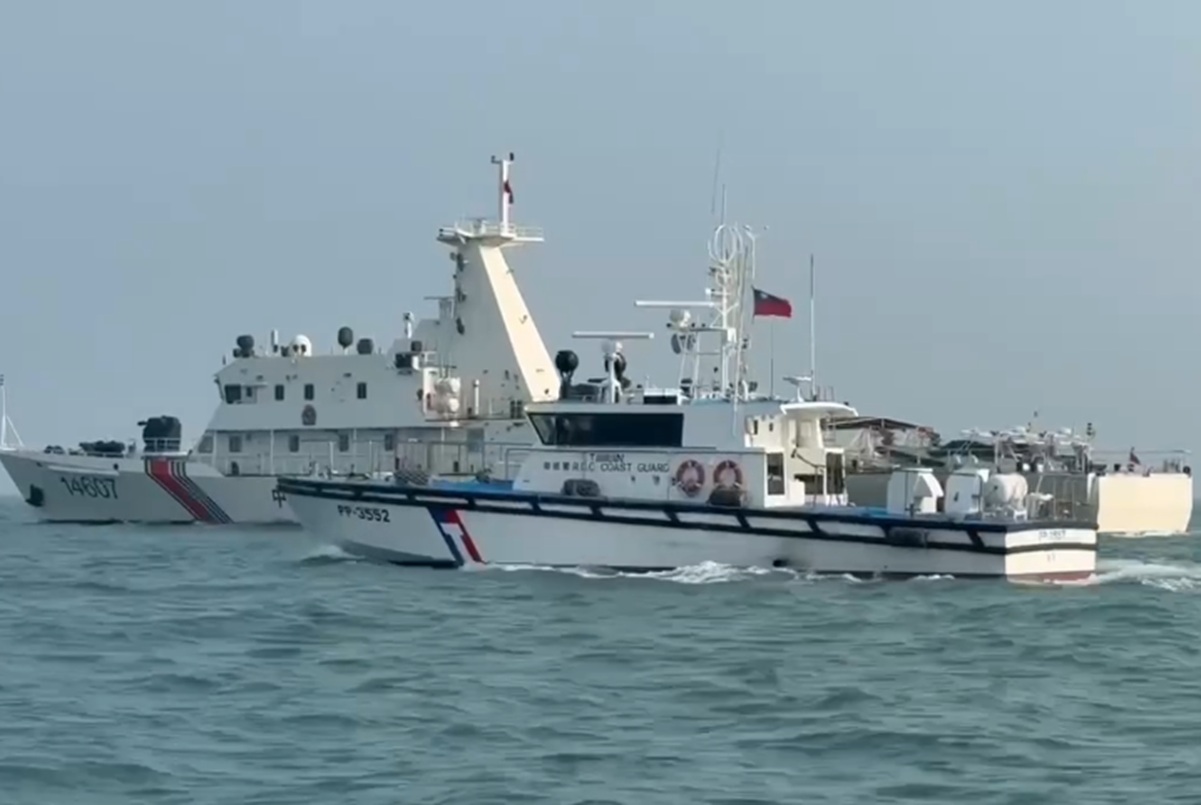
Taiwan's coast guard said it had tracked four Chinese coast guard vessels sailing into restricted waters around Kinmen, a Taiwan-administered outlying island province where Taiwanese troops are stationed and whose closest point lies just a mile off the Chinese coast.
The ships entered restricted waters Wednesday afternoon and were said to have departed by Thursday morning.
The Taiwanese coast guard expressed "strong condemnation," saying it marked the 68th such incursion since they began early last year. Analysts have said the patrols, which China has said are to assert its jurisdiction and protect fishermen, are to normalize its coast guard presence in the waters around Kinmen.
Analysis
Ben Lewis, defense analyst and co-founder of PLA Tracker, told Taiwan Plus: "Essentially, what we've seen is the PLA gradually expands its presence on a daily basis to surround Taiwan and integrate new capabilities.
"Kind of more far-reaching training exercises on a smaller level and a larger level, essentially to not only train their forces to strain Taiwan's forces, but really to kind of get used to operating in an international operating environment that is the Taiwan theater."