
After the Hunt Would Like to Touch a Nerve

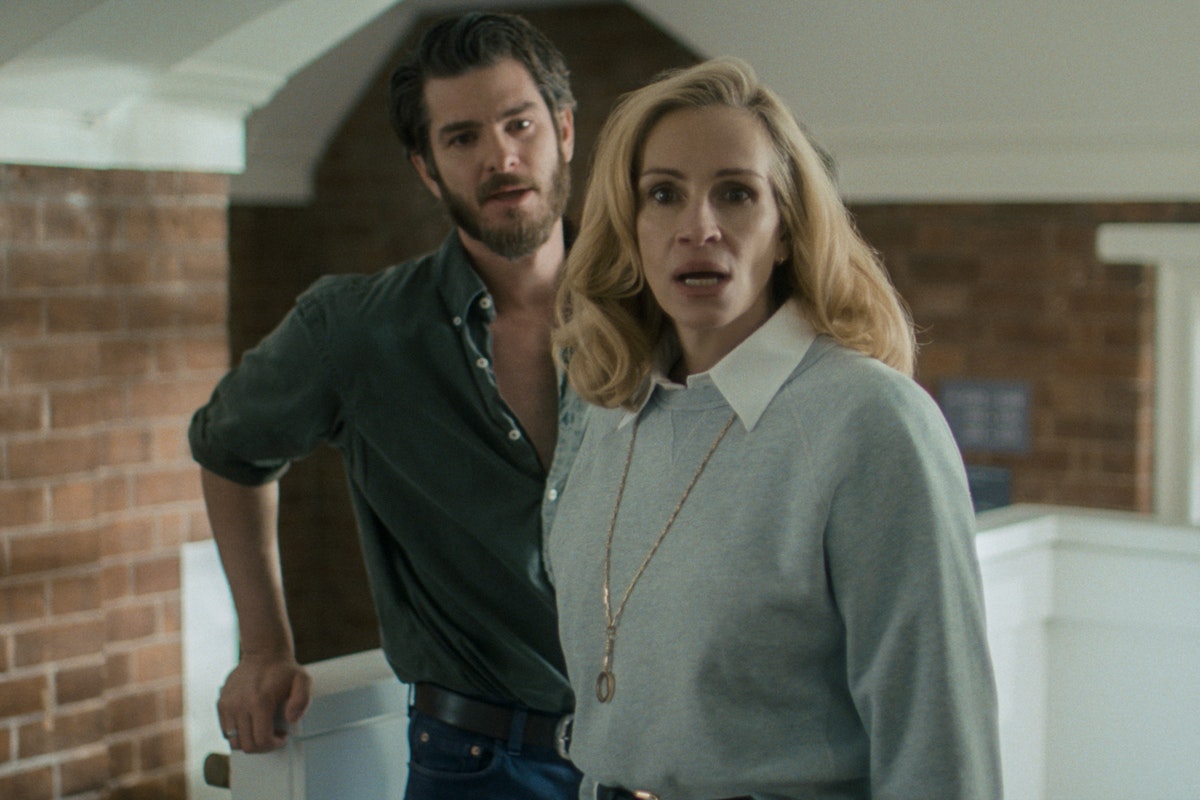
Lean and lanky and given to casually draping himself across chairs and couches, as well as their occupants, Hank could be the evil twin to the milquetoast Harvard undergrad that Garfield played in The Social Network:his know-it-all nerdiness is a tool of seduction. Hank enjoys styling himself as a straw man for the blame-patriarchy crowd; he’d just as soon hand the Zoomers in his midst a match. Maggie, meanwhile, is a promising scholar, neck-deep in an apparently excellent dissertation about “performative discontent.” She knows full well that Yale’s white power brokers are apt to treat her as a mascot and a meal ticket (her parents are donors). She’s the polished apple of Alma’s eye—a thoroughbred teacher’s pet—and reflects the older woman’s anxious, narcissistic gaze back at her: Mirror, mirror on the wall / who’s the wokest prof of all?
There is one more important character: Alma’s husband, Frederik (Michael Stuhlbarg)—the baker of the tárt, and a psychiatrist perceptive enough that he can afford to take clients at home on his own schedule. Frederik is used to people falling in desperate, unrequited love with his wife: It’s what he did 30 years ago, for better and for worse. Hank’s shameless, in-your-face flirtations worry him less than Maggie’s combustible mix of ambition and insecurity.
One night, after much talk of Heidegger and Hegel and their various private improprieties—and too many drinks, served open-bar at Alma and Frederik’s expense—Hank and Maggie walk home together through New Haven, en route to a friendly nightcap at the latter’s apartment. The next morning, Maggie shows up at Alma’s place, soaked from the rain and shivering. She reports, through nervous tears, that something went wrong—that Hank, inebriated and insistent, crossed the line. That Maggie won’t say exactly which line was crossed raises alarm bells for Alma, who has her own tricky, age-gap rapport with Hank. That Alma seemingly requires clarification on this point makes Maggie apoplectic, although whether this is out of indignation, disappointment, or anxiety about a lack of corroborating details is hard to say.